There’s a low-cost way to verify your passport for a Form W-7 that most applicants are never told about — and it lets you keep your passport in your pocket. Here’s how it works, country by country.
| QUICK ANSWER
To get an ITIN, your Form W-7 must include either your original passport or a certified copy from an approved source. The IRS will not accept a copy stamped by an ordinary notary. But it does accept a copy certified by your passport’s issuing authority — or by a consular officer at a U.S. embassy or consulate. For applicants abroad who don’t want to post their passport overseas for weeks, that embassy appointment is often the cheapest safe route. |
Meet Charlotte — passport in hand, ITIN in limbo
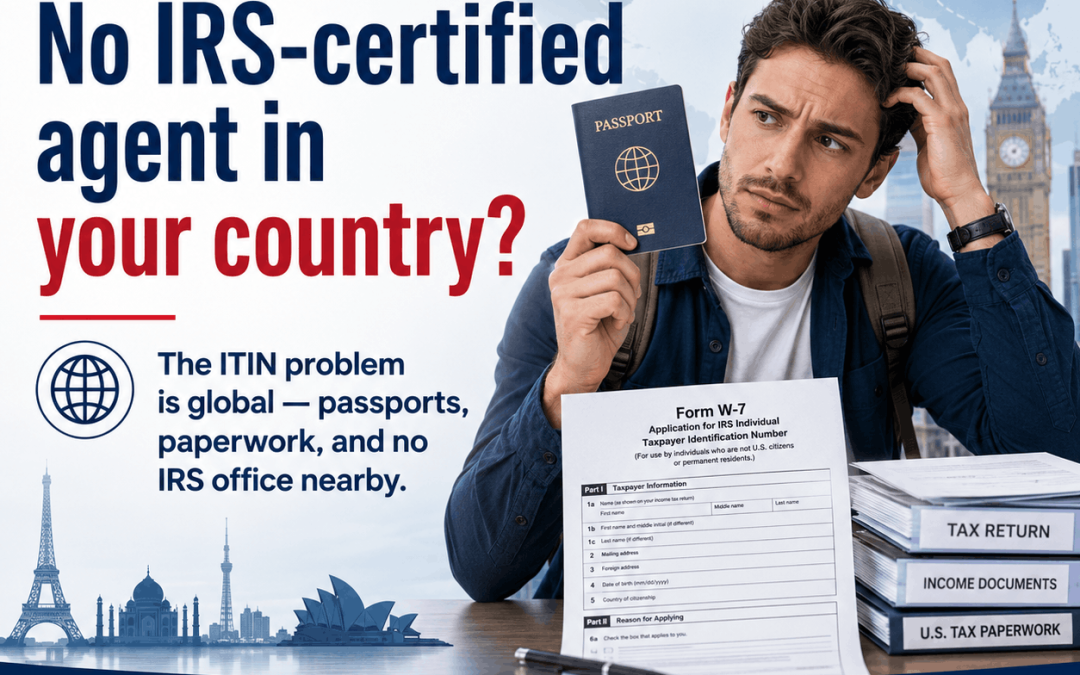
Charlotte lives in Leeds. She co-owns a small holiday rental in Florida with her brother, and this year she finally has to file a U.S. tax return and get an ITIN — an Individual Taxpayer Identification Number, the nine-digit number the IRS issues to people who need to file but can’t get a U.S. Social Security number. To get one, she has to send the IRS a Form W-7 and prove who she is.
The proof is the problem. Charlotte travels for work and is not about to drop her only passport in the post to a service centre in Austin, Texas, and wait weeks to get it back. She can’t pop into a U.S. tax office because there are none outside America. And the first agent she rang quoted a fee that made her wince. This is the exact corner thousands of applicants get stuck in — and it’s usually because nobody walked them through all of their options.
What are your real options to verify your ID for a W-7?
There are four legitimate ways to satisfy the IRS that your passport is genuine. Most people only hear about the first three.
- Mail your original passport to the IRS. It’s free, but you part with your passport for what can be a couple of months. For anyone who travels, that’s a non-starter.
- Visit an IRS Taxpayer Assistance Center (TAC). Also free, and they hand your documents straight back — but TACs only exist inside the United States and run by appointment. No use to you if you’re abroad.
- Use a Certifying Acceptance Agent (CAA). A CAA can verify your passport so you keep it, then send the IRS proof. Convenient, but fees vary widely from firm to firm and country to country.
- Get a certified copy — from the issuing authority or a U.S. embassy. This is the route that quietly solves Charlotte’s whole problem.
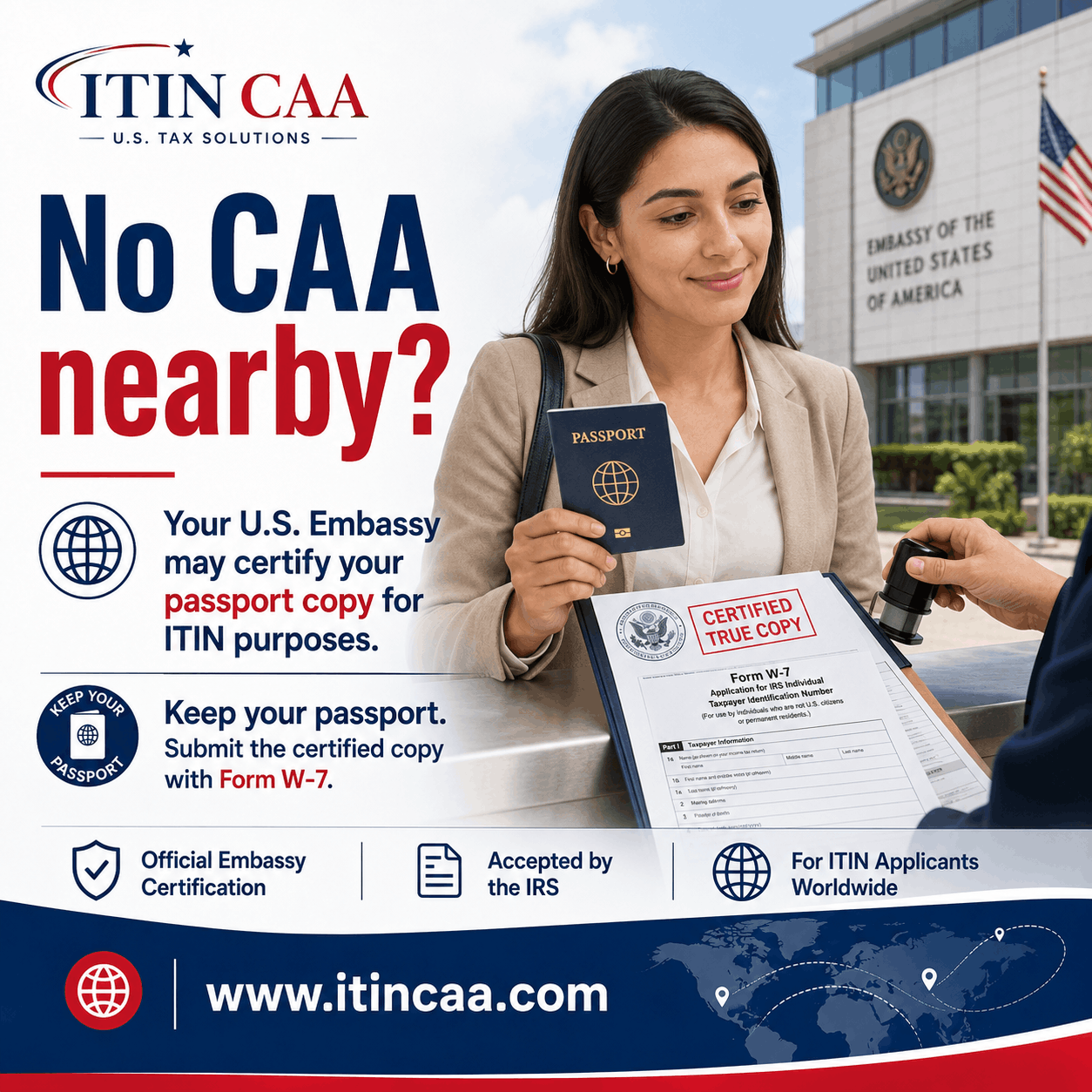
The detail that trips everyone up: certified is not notarized
Here’s the mistake I see more than any other. Someone walks into a local notary, gets a crisp stamp on a photocopy of their passport, mails it off — and months later the W-7 bounces back rejected. The IRS is blunt about this: it does not accept notarized copies of identity documents. A notary witnessing a signature is not the same thing as an authority certifying that a copy is a true copy of the original.
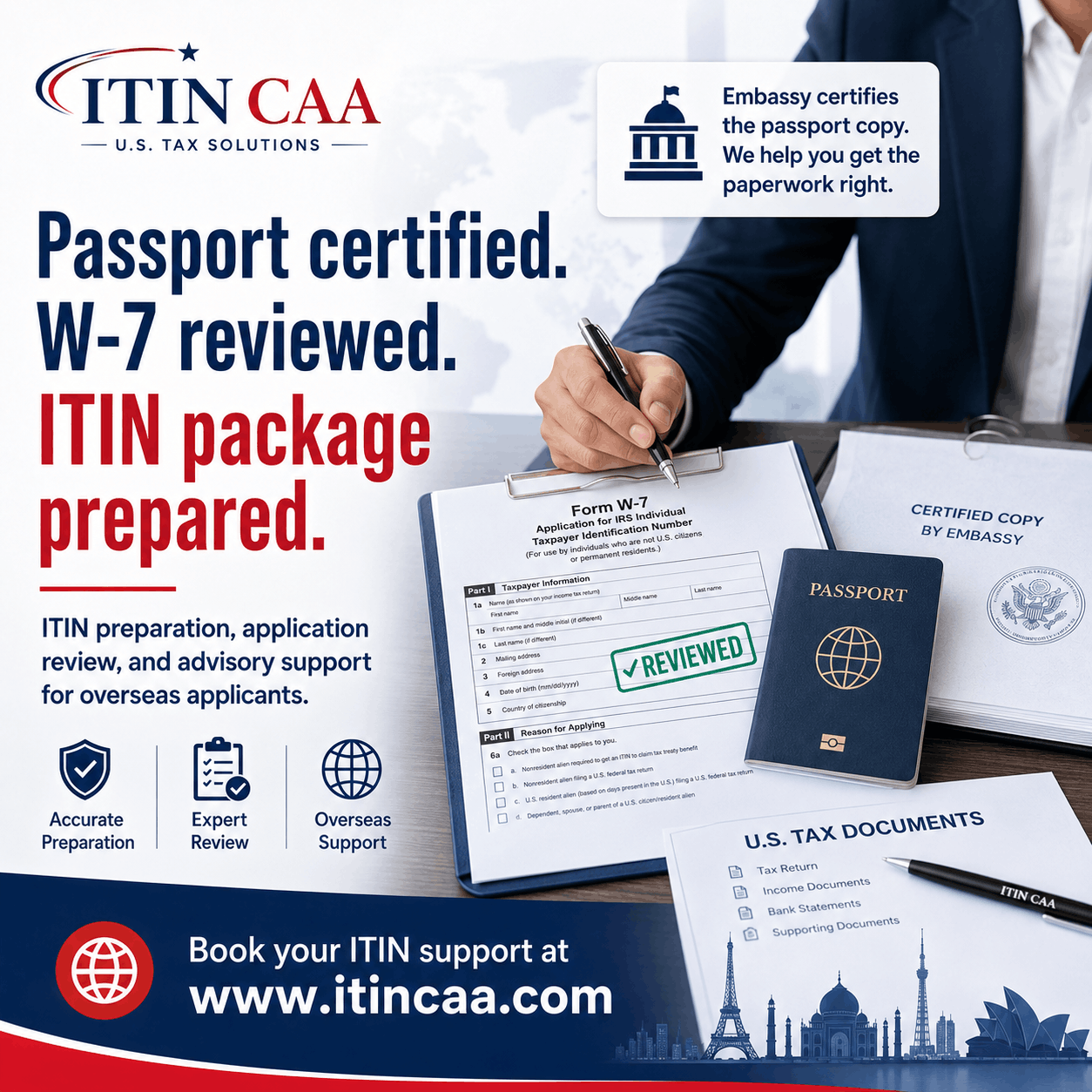
What the IRS will accept is a certified copy from one of two places: the agency that issued your passport (for Charlotte, that’s His Majesty’s Passport Office), or a consular officer at a U.S. embassy or consulate. A consular officer can certify the copy of your passport for a modest per-seal fee, you walk out with your passport still in your bag, and the certified copy goes to the IRS with your W-7. If you’re a confident filer with a straightforward case, this can be the most cost-efficient path there is.
One honest caveat, and it’s the whole reason firms like ours exist: the embassy certifies your document. It does not check your application. The consular officer won’t tell you whether your W-7 reason box is correct, whether your tax return supports the application, or whether your dependent paperwork is complete. Get the form wrong and you’ll still be rejected — certified copy and all.
The UK in practice: how Charlotte books it
The U.S. Embassy in London and the Consulates General in Belfast and Edinburgh provide notarial and ID-certification appointments to applicants of any nationality, and they specifically mention ITIN identity verification. Availability is limited, so book early. Here is the path step by step.
- Open the U.S. Mission UK appointments page and choose a notarial appointment. If you’re in England or Wales, book at Embassy London. In Northern Ireland, book at Consulate General Belfast; in Scotland, contact Consulate General Edinburgh. On the scheduler, select the service type “Notarial.”
- Prepare your Form W-7 package first. Bring your original passport and a clean photocopy of the photo page. Don’t sign anything in advance — you sign only when the consular officer directs you to. Consular staff cannot explain or assemble your documents, so arrive ready.
- Attend in person at the Embassy (33 Nine Elms Lane, London SW11 7US) or your chosen consulate. Plan for roughly 90 minutes on site; security and queues take time.
- Pay the consular fee per seal. The U.S. consular notarial fee is $50 for each seal placed on a document, paid on the day. Budget one seal per document you need certified, and check accepted payment methods first.
- Leave with your certified copy — and your passport. Your original never leaves the country. That’s the whole advantage over posting it to Austin.
- File the certified copy with your W-7 and tax return to the IRS. Because the copy is certified, you don’t mail the original passport. Keep a scan of everything you submit.
Applying from another country? The live version of this article on itincaa.com includes a country selector that gives the same booking steps for other locations. The consular process is broadly the same worldwide — confirm the exact booking screens and fee on your local U.S. embassy page first.
So who should actually use the embassy route?
Use it if you’re outside the U.S., you don’t want to surrender your passport, you can’t reach a TAC, and your situation is clean enough that you trust your own Form W-7. If any part of that makes you nervous — the reason code, the tax return that has to ride along with it, a spouse or child on the application — the smart move is to let someone check the paperwork first, then take that checked package to your embassy appointment. (If you’re a U.S. citizen or green-card holder living abroad rather than a foreign national, your path is different; our sister site ustax4expats.com covers expat filing in detail, and taxandaccountinghub.com covers general U.S. personal tax.)
Key takeaways
- The IRS accepts your original passport, an issuing-authority certified copy, or a U.S. embassy/consulate consular certification — never a plain notarized copy.
- The embassy route lets you keep your passport instead of mailing it abroad for weeks.
- Embassy appointments are by appointment only and availability is tight, so book early. A per-seal consular fee applies.
- The embassy certifies the copy; it does not review your W-7 or your tax return. A wrong form still gets rejected.
Questions Charlotte asked next
Can Charlotte really keep her passport if she uses the embassy?
Yes. The consular officer certifies a copy of her passport and hands the original straight back. That certified copy goes to the IRS with her Form W-7, so her passport never leaves the country.
Why was her friend’s notarized passport copy rejected?
Because the IRS does not accept notarized copies for ITIN applications. A high-street notary witnesses signatures; it does not certify, on behalf of an authority, that a copy is a true copy. Only the issuing agency or a U.S. embassy/consulate certification clears that bar.
Does the embassy check that her W-7 is filled in correctly?
No. Consular staff certify the document copy only. They cannot review your W-7, confirm your reason for needing an ITIN, or check the tax return that must usually accompany it.
What if no embassy appointment is available for months?
It happens — slots are limited. Two fallbacks: ask your passport’s issuing authority whether it provides certified copies, or use an IRS-approved Certifying Acceptance Agent who can verify your passport without you mailing it anywhere.
Does this work for a foreign spouse or dependents too?
The same certified-copy rules apply, but dependent applications have extra documentation requirements and tighter rules. A quick check before your appointment saves a rejection, because you only get one set of certified copies per visit.
| A NOTE ON HOW WE WORK RIGHT NOW
Our own IRS Certifying Acceptance Agent agreement is temporarily paused, so for the moment we don’t certify passports, verify original identity documents, or issue the Form W-7 Certificate of Accuracy in-house. That doesn’t slow your ITIN down. We handle the full advisory and coordination and prepare and file your Form 1040 or 1040NR, and we’ll guide you through getting your passport certified at your U.S. embassy or the issuing authority — or refer you to a trusted, IRS-approved Certifying Acceptance Agent within our network for that one step. We expect to resume our own certification services in early 2027. |
Confident on the embassy step but unsure about the form?
That’s the safest order: have the W-7 and the return checked first, then take a clean package to your appointment. ITINCAA prepares and reviews Form W-7 applications, files Form 1040 and 1040NR for foreign filers, and untangles IRS notices — so your one embassy appointment actually lands.
Get your ITIN application checked at www.itincaa.com.