CHAPTER I
Why identity verification is a legal requirement, not a formality.
An ITIN — Individual Taxpayer Identification Number — is issued by the IRS to people who must file a U.S. federal tax return but cannot get a Social Security Number. Because the number is tied to your tax record forever, the IRS cannot issue it on trust. Federal regulations require that every applicant prove two things: identity (you are who you say you are) and foreign status (you are not a U.S. citizen or permanent resident).
The proof comes from the documents listed in IRS Publication 1915 — and, critically, from how those documents are reviewed. The IRS recognises only three lawful ways to satisfy this verification step. There is no fourth.
FROM IRS PUBLICATION 1915
“All documents must be original documents or copies certified by the issuing agency.”
— IRS Publication 1915 — “Understanding Your IRS Individual Taxpayer Identification Number,” Reminders, item 1.
CHAPTER II
The three IRS-approved paths to verify your passport.
Each path solves the same problem — proving identity and foreign status to a federal standard — but they differ in cost, convenience, and how long you part with your passport. The IRS lists exactly these three options in Publication 1915 and Publication 4520.
Mail your original passport to the IRS
You ship your original passport (or an issuing-agency-certified copy) to the IRS Austin Service Center, attached to Form W-7 and your tax return.
The IRS aims to return your document within 60 days, by post, to the address you list on the form. During that window, you have no passport. [High risk · Long wait]
Visit an IRS Taxpayer Assistance Center (TAC)
Designated TAC offices in the United States can review your originals in person and return them the same day. Service is by appointment only — call 1-844-545-5640.
This route requires you to be physically inside the U.S. and to travel to a designated office. [U.S. only · By appointment]
[ RECOMMENDED ]
Use a Certifying Acceptance Agent (CAA)
A CAA is a person or firm authorised by the IRS — under a written agreement — to verify your passport on the IRS’s behalf and submit a Certificate of Accuracy (Form W-7 COA) confirming what was reviewed.
You keep your passport. The CAA sees it, certifies it, and only copies are sent to the IRS. [No passport mailed]
Why this matters for international clients
If you live outside the United States — in the U.K., the EU, Asia, the Middle East, or anywhere else — option (ii) is unavailable to you. That leaves mailing your passport to Texas for two months, or working with a CAA. For most clients with travel, work, or visa needs, the CAA route is the only practical one.
CHAPTER III
Yes, a CAA can verify your passport by video call — but only under one strict rule.
This is the part that most online articles get wrong, and it’s the part the IRS is unambiguous about. The rule comes directly from Publication 4520, the Acceptance Agents’ Guide for Individual Taxpayer Identification Number. Read it carefully:
IRS PUBLICATION 4520, PART 4
“Generally, ITIN applicants must submit the required documentation during a personal interview with the Acceptance Agent. Applicant interviews can be conducted either by face-to-face or through video conferencing (i.e. SKYPE, FACETIME, ZOOM etc.), but the Acceptance Agent must have the original identification documents in their possession during the interview in order to see the security features and authenticate the documents.”
— IRS Publication 4520 — “What are the procedures for collecting, reviewing and maintaining required documentation for assignment of an ITIN?” Part 4.
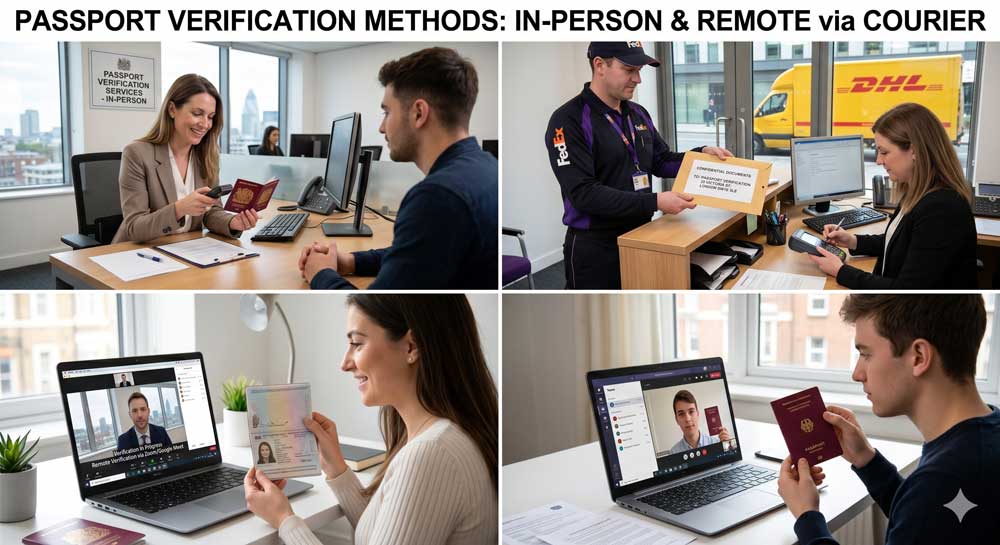
Translated into plain language: a video call is allowed by the IRS, but the CAA on the other end of that call must be physically holding your original passport while you are on screen. The CAA is examining the holograms, the chip, the watermark, the laminate, the stitching — the security features your phone camera cannot reliably show. There is no version of this rule that lets a CAA verify your passport from a photograph or scan you upload.
How this works in practice
There are essentially two compliant arrangements that meet the IRS’s “in possession” requirement:
- You meet the CAA in person first — typically at the firm’s office or a coordinated location — and the supporting paperwork (tax return, exception documents, signatures) is then completed by video at a later time.
- You courier your passport to the CAA using a tracked, insured service. The CAA verifies it in their hands during a live video call with you, then returns it to you the same way. The passport never leaves a controlled chain of custody.
What does not meet the rule, regardless of how convenient it sounds: a CAA reviewing a scan, a phone photograph, an emailed PDF, or a screen-shared image of your passport. The IRS requires the original to be in the agent’s hands during the live interview.
CHAPTER IV
“Certified by the issuing agency” — what that phrase actually means.
If you do not want to part with your passport and you cannot meet a CAA, the IRS does accept one alternative: a copy of your passport certified by the agency that issued it. This is the only kind of certified copy the IRS accepts. Three points of practical importance follow:
Who counts as “the issuing agency”
For a passport, the issuing agency is the government department that printed it — for example, His Majesty’s Passport Office in the United Kingdom, or the U.S. Department of State. To produce a valid certified copy, you generally have to apply through that agency and they stamp, sign, and seal a copy as a true reproduction of the original on their record.
What U.S. embassies and consulates can do (overseas)
Publication 1915 confirms that “officers at U.S. Embassies and Consulates overseas may provide certification and authentication services.” If you are abroad, the U.S. Consular Section of an American embassy can in some cases certify a copy of your foreign passport. Hours and availability vary — contact the American Citizens Services desk before travelling there.
What a notary public absolutely cannot do
This is where most applications go wrong. A notarised copy of a passport is not acceptable to the IRS. A solicitor, a notary public, a JP, or a “certified true copy” stamp from a high-street legal office does not meet the standard set out in Publication 1915. The only narrow exception is for spouses and dependents of U.S. military personnel applying from overseas APO/FPO addresses — and even then, a copy of the service member’s military ID must accompany the application.
IRS PUBLICATION 1915
“Notarized copies are only acceptable for dependents and spouses of U.S. military personnel applying from overseas without an SSN who need an ITIN.”
— IRS Publication 1915 — “What are the documentation requirements when applying for an ITIN?” Documentation, item 4.
CHAPTER V
The thirteen documents the IRS accepts — and what each one proves.
The IRS will accept only the following thirteen documents as proof of identity and foreign status. Anything not on this list — including utility bills, marriage certificates, baptismal records, library cards, or country-issued tax numbers — cannot be used to establish either category.
| DOCUMENT | FOREIGN STATUS | IDENTITY |
|---|---|---|
| Passport — Stand-alone | ✓ | ✓ |
| U.S. Citizenship and Immigration Services (USCIS) photo identification | ✓ | ✓ |
| Visa issued by the U.S. Department of State | ✓ | ✓ |
| U.S. driver’s license | — | ✓ |
| U.S. military identification card | — | ✓ |
| Foreign driver’s license | — | ✓ |
| Foreign military identification card | ✓ | ✓ |
| National identification card (with name, photo, address, DOB, expiry) | ✓ | ✓ |
| U.S. state identification card | — | ✓ |
| Foreign voter’s registration card | ✓ | ✓ |
| Civil birth certificate (required for dependents under 18 unless passport) | ✓ if foreign | ✓ |
| Medical records (dependents under 6 only) | ✓ if foreign | ✓ |
| School records (dependents under 24 only) | ✓ if foreign | ✓ |
★ The passport advantage
Of the thirteen acceptable documents, the passport is the only one that proves both foreign status and identity on its own. With any other document, you will need at least two — one for each category, with a recent photograph on at least one. This is why nearly every ITIN application is built around the passport.
CHAPTER VI
What you keep, what your CAA sends to the IRS.
The single most valuable thing a Certifying Acceptance Agent does for primary and secondary applicants is allow you to keep your original passport in your hands. Here is exactly what stays with you and what the CAA forwards to the Austin Service Center:
What stays with you
- Your original passport — once the CAA has reviewed it on a live in-person or video interview.
- Any other original supporting documents you presented (foreign driver’s licence, national ID card, etc.).
- A copy of the entire application package for your records.
What the CAA sends to the IRS
- Your signed Form W-7 (Application for IRS Individual Taxpayer Identification Number).
- The CAA’s Form W-7 (COA) — the Certificate of Accuracy, the legal certification that the CAA personally reviewed and authenticated your originals.
- Copies of your passport (and any other ID reviewed) — not the originals themselves, for primary and secondary applicants.
- Your attached U.S. federal tax return, unless you qualify under one of the five Exceptions (passive income, treaty benefits, mortgage interest, FIRPTA, T.D. 9363).
- Any supplemental documents required for an Exception or for a dependent’s U.S. residency.
For dependents, the rule is narrower: a CAA may only authenticate a dependent’s passport or civil birth certificate. Any other dependent document (medical records, school records, foreign ID cards) must still be sent to the IRS as originals or issuing-agency-certified copies.
CHAPTER VII
Common myths, briskly corrected.
MYTH
“I can apply for an ITIN entirely online, no documents needed.”
No. The IRS does not accept ITIN applications by upload alone. Form W-7 is paper-based and must be accompanied by physical originals, issuing-agency-certified copies, or — through a CAA — copies authenticated under a Certificate of Accuracy.
MYTH
“A notary or solicitor can certify my passport copy.”
Not for IRS purposes. Only the agency that issued the document can produce a copy the IRS will accept. The single exception is for U.S. military spouses and dependents applying from APO/FPO addresses overseas.
MYTH
“My CAA can just verify a high-resolution scan I email.”
Not under IRS rules. Publication 4520 requires the CAA to have the original physically in hand during the interview to inspect security features. A scan does not satisfy this and exposes both you and the agent to compliance action.
FACT
“A video call is allowed if the CAA holds my original passport.”
Yes. The IRS expressly permits video conferencing — Skype, FaceTime, Zoom — for the applicant interview, provided the original documentation is in the CAA’s possession at the time of the call.
MYTH
“An ITIN gives me the right to work in the U.S.”
No. An ITIN is for federal tax reporting only. It does not authorise employment, change immigration status, or qualify you for Social Security benefits or the Earned Income Tax Credit.
FACT
“My ITIN can expire.”
Yes. ITINs not used on a U.S. federal tax return for three consecutive years expire on December 31 of the third year. ITINs assigned before 2013 and never renewed are already expired and must be renewed before use.
CHAPTER VIII
The CAA process, end to end.
For most international applicants, the path through a Certifying Acceptance Agent looks like this:
01 Initial consultation & eligibility check
We confirm you actually need an ITIN — many applicants don’t, or qualify for an Exception that avoids attaching a full tax return. We identify which “reason” box on Form W-7 applies and what supporting documents will be required.
02 Document collection
You complete Form W-7 and gather your passport (or alternative qualifying documents), plus any supplemental papers — partnership agreements, withholding-agent letters, mortgage documents, school certifications — required for your specific reason or Exception.
03 The verification interview
Conducted in person or by video call. Either way, the CAA physically holds your original passport during the interview, examining security features, comparing the photograph to you on screen or across the desk, and verifying the entry stamp where required.
04 Certificate of Accuracy & submission
The CAA prepares Form W-7 (COA), signs it under penalty of perjury, and sends it to the IRS Austin ITIN Operations centre with your Form W-7, copies of your authenticated documents, and your tax return or Exception package.
05 IRS processing
The IRS typically issues an ITIN within seven weeks (nine to eleven during peak season, or for filings from abroad). Because the CAA submitted the application, the assignment notice (CP 565) arrives directly to the CAA as well as to you.
06 Use of your ITIN
You can begin using the ITIN immediately on paper-filed returns. Note that returns using a newly issued ITIN cannot be e-filed in the same calendar year — you must wait until the following year to e-file.
CHAPTER IX
Frequently asked, briskly answered.
Do I need to be in the United States to get an ITIN through a CAA?
No. You can be anywhere in the world. The CAA route was designed in part precisely so that overseas applicants — who cannot visit a U.S. Taxpayer Assistance Center — could verify their identity without mailing their passport across an ocean.
Can my spouse and children also get ITINs on the same call?
Sometimes. Since the Tax Cuts and Jobs Act of 2017, spouses and dependents are only eligible for an ITIN if they are claimed for an “allowable tax benefit” (head of household, qualifying surviving spouse, AOTC, premium tax credit, child and dependent care credit, or credit for other dependents) or are filing their own return. We assess eligibility before scheduling the verification.
What if my passport doesn’t have a U.S. entry stamp?
For primary applicants, the passport remains a stand-alone document. For dependents (other than dependents from Canada or Mexico, or dependents of U.S. military stationed overseas), a passport without a U.S. entry stamp is no longer accepted on its own — additional documents proving U.S. residency are required, with specific items by age.
How long will the IRS hold my passport if I mail it?
The IRS aims to return original documents within 60 days of submission. From abroad, with international post, the round trip can be longer. This is one of the strongest practical reasons to use a CAA: your passport never leaves your control for more than the duration of a verification meeting.
Can I e-file my U.S. tax return after I get my ITIN?
Not in the calendar year you receive it. The IRS does not permit e-filing of any return — including prior-year returns — using an ITIN in the year that ITIN was issued. You can e-file the following calendar year onwards. Your first return alongside the W-7 will be paper-filed.
Does an ITIN expire?
Yes. An ITIN expires on December 31 of the third consecutive year it has not appeared on a U.S. federal return. ITINs issued before 2013 that were never renewed have already expired. A renewal application uses the same Form W-7 and the same identity verification process — meaning the same three IRS-approved paths.
What if my application is rejected or suspended?
The IRS will issue either a CP 566 (suspense — additional information required) or a CP 567 (reject). Working with a CAA significantly reduces the rejection rate, since the application has already been pre-checked against the rules in Publication 1915 before it is mailed.
Will a CAA fee be cheaper than the cost of a courier round-trip for my passport?
For most international clients, comfortably yes — once you account for tracked, insured international courier services in both directions, currency hedging on a long IRS hold, and the very real possibility of needing the passport for travel during the IRS’s processing window. But the strongest case for a CAA is not cost; it is custody and certainty.