If you are a non-resident investor with an interest in a US business, you have probably come across this advice at some point:
“Own an LLC? You need an ITIN. Own a C Corp or S Corp? You don’t.”
It is a rule of thumb that gets repeated often – and it is not wrong exactly, but it is incomplete. Depending on how your income is treated by the IRS, the picture can look quite different. This post sets out the practical rules clearly, so you know where you stand before making any filing decisions.
What is an ITIN?
An ITIN (Individual Taxpayer Identification Number) is a nine-digit tax ID issued by the IRS to individuals who are not eligible for a Social Security Number but who have a US tax obligation. It is issued to people, not companies. It does not grant work authorisation, immigration status, or any benefit outside the US tax system. It is used specifically to file returns such as Form 1040-NR and to document treaty positions or support refund claims.
Foreign Owner of a US LLC – Why an ITIN Is Usually Required
When a non-resident owns a US LLC that is treated as a disregarded entity or a partnership for US federal tax purposes, the LLC itself does not pay tax. Instead, the income or loss passes through directly to the owner’s personal return.
That means the owner files a Form 1040-NR as an individual. Since there is no Social Security Number in play, an ITIN is required to submit that return correctly. This is why foreign LLC owners are almost always told: You need an ITIN. The tax sits with you personally, not with the company.
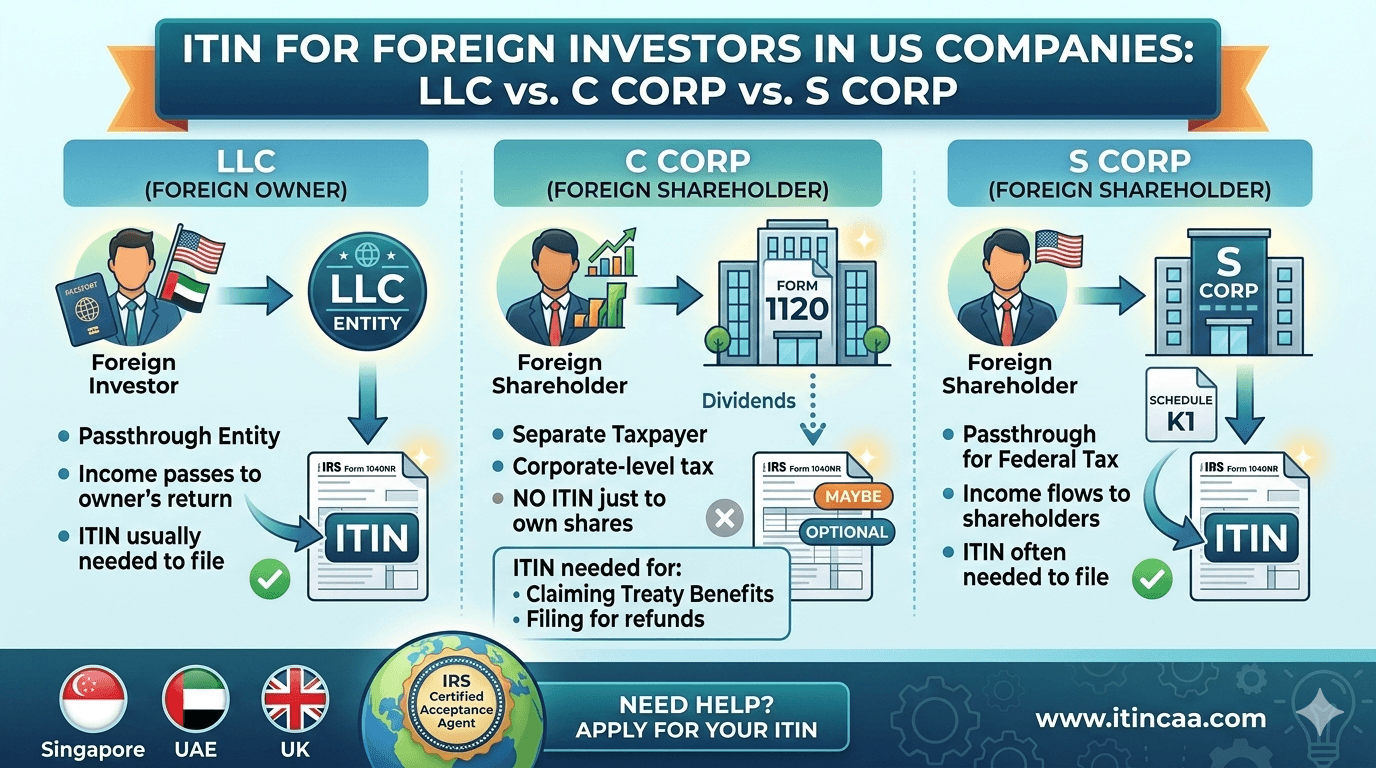
Foreign Shareholder of a C Corp – ITIN Is Usually Optional
A C Corporation is a separate taxpayer. It files Form 1120 and pays its own corporate-level tax. Simply owning shares in a C Corp does not, by itself, create a personal US tax filing requirement for a foreign investor. The company uses an EIN, not an ITIN.
That said, an ITIN can still become relevant in a C Corp situation when:
- You want to file Form 1040-NR to address dividend income directly, for example, where tax has been over-withheld at source, and you want a refund.
- You are relying on a tax treaty, such as the US-UK treaty, to reduce or eliminate withholding, and the IRS requires a valid taxpayer identification number in your name to process the claim.
- You are building a documented US tax history for future compliance purposes.
Many non-resident investors in US C Corps receive dividends with withholding applied at source (typically 30%, reduced under treaty to 15% for UK residents) and never file Form 1040-NR at all. In those cases, no ITIN is needed.
S Corp Shareholders – ITIN Often Applies
An S Corporation is incorporated under state law but is treated as a pass-through entity for US federal tax. Each shareholder receives a Schedule K-1 each year showing their allocated share of income or loss, which they must then report on their own individual return.
For a foreign shareholder who does not qualify for an SSN, this means filing Form 1040-NR with a valid ITIN. The same pass-through logic that applies to LLC owners applies here. The income is taxed at the shareholder level, so the individual filing requirement – and the ITIN requirement – follows.
For more detail on how pass-through taxation works for non-resident owners, US Tax for Expats covers the distinction between ITIN and EIN and when each applies to LLC and corporate structures.
A Simple Framework for Non-Resident Investors
Entity pays its own tax (standard C Corp) – Income is taxed at the company level via Form 1120. You do not usually need an ITIN just to own shares.
Income passes through to you personally (LLC, S Corp, or individual dividend filing) – You report the income on Form 1040-NR. You will generally need an ITIN unless you qualify for an SSN.
Withholding only situation (many C Corp investors) – Dividends are taxed at source under the treaty. You may have no personal filing requirement and no need for an ITIN.
Why Use an IRS Certified Acceptance Agent?
If you do need an ITIN, working with an IRS Certified Acceptance Agent (CAA) is the most reliable route. A CAA is authorised by the IRS to verify your identity documents and certify your passport directly, which means you do not need to send original documents to the IRS. This avoids the risk of documents going missing in transit and significantly reduces the chance of your ITIN application being rejected.
Our team operates as IRS-approved CAAs with representatives in the United Kingdom, UAE, Singapore, and India. We assist with ITIN applications, Form 1040-NR filings, EIN applications, and related US tax compliance for non-resident investors and expats across the globe.
If you need to discuss your situation, visit Tax and Accounting Hub, US Tax for Expats, or ITINCAA to contact our team directly.