Kader Ameen, EA, FMAAT. Official IRS sources checked 18 October 2026.
The 2025 tax law changed who can claim the Child Tax Credit. If anyone in your family uses an ITIN, check whose number is on the return before you assume the credit is gone, or that it’s still there.
The quick answer on ITIN Child Tax Credit rules
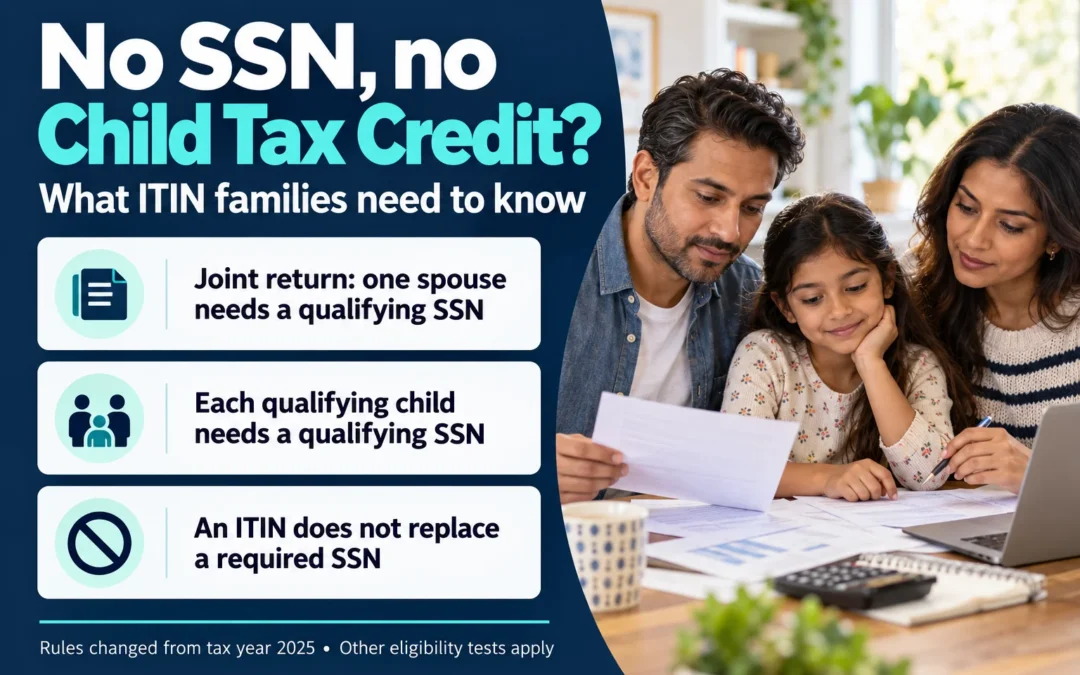
From tax year 2025, the taxpayer needs a Social Security number valid for employment to claim the Child Tax Credit or the refundable Additional Child Tax Credit. On a joint return, it’s enough for one spouse to have that SSN. The other spouse needs an SSN or an ITIN issued by the return deadline. Each qualifying child also needs the required SSN. An ITIN can’t stand in for a required SSN. [1, 2]
If your family can’t claim the Child Tax Credit, you may still qualify for the separate Credit for Other Dependents, worth up to $500 per eligible dependent. It isn’t automatic, and it isn’t a refundable payment. [1]
One family, two different tax numbers
Here’s a typical situation. An American parent lives in Singapore with a foreign spouse and their daughter. The American parent and the daughter both have qualifying SSNs. The spouse isn’t eligible for an SSN and uses an ITIN.
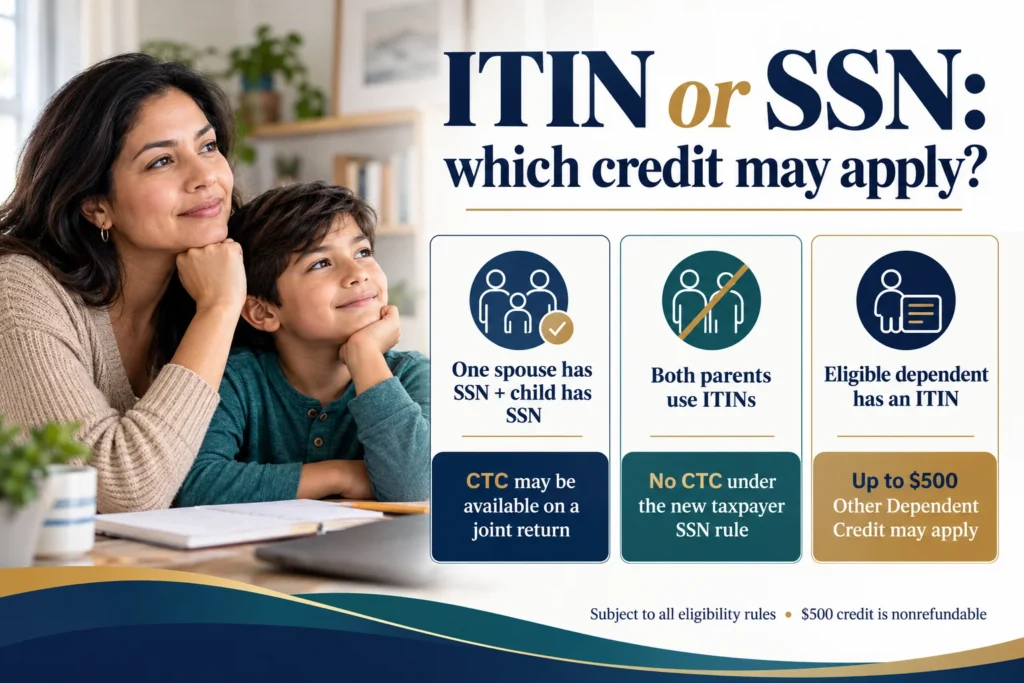
They’ve heard that ITIN families have lost the Child Tax Credit. That headline doesn’t tell their whole story. If they validly file a joint return and meet the other tests, the spouse’s ITIN on its own doesn’t stop the claim. Before choosing to file jointly with a nonresident spouse, though, look at any residency election you’d need to make and what it means for worldwide income. Getting an ITIN doesn’t make that election for you. (Our guide on ITIN for a foreign spouse filing jointly explains this in more detail.) [2, 8]
Now change the facts. If both parents use ITINs, the new taxpayer SSN rule stops a Child Tax Credit claim, even if their daughter has an SSN. And if a child has only an ITIN, that child can’t qualify for this credit, even when a parent has an SSN. [1, 2]
What else does your child need to meet?
Having the right numbers is only the first check. For tax year 2025, the child generally must be under 17 at the end of the year, meet the relationship and support tests, live with you for more than half the year and qualify as your dependent. Some residence situations have exceptions. The child must also be a U.S. citizen, U.S. national or U.S. resident alien. [1, 7]
The maximum 2025 Child Tax Credit is $2,200 per qualifying child. It starts to phase out once modified adjusted gross income goes above $400,000 for married filing jointly, or $200,000 for other filing statuses. So a high income can reduce or wipe out the credit even when every SSN test is met. These are 2025 figures, so use the final instructions for the year you’re actually filing. [1, 2]
When the $500 Credit for Other Dependents may help
The Credit for Other Dependents can cover some dependents who don’t qualify for the Child Tax Credit. That includes an otherwise eligible child with an ITIN, or an older dependent. The maximum is $500 per dependent, subject to income and tax liability limits. It reduces the tax you owe. It doesn’t create a refund on its own. [1, 6]
Check the dependent’s status carefully. For this credit, living in Canada or Mexico isn’t enough on its own: the person must be a U.S. citizen, U.S. national or U.S. resident alien. A foreign child living abroad doesn’t become eligible just because an ITIN has been issued. And a spouse is never your dependent. [2, 7]
You, your spouse on a joint return and each dependent need the right tax identification numbers by the return due date, including valid extensions. A timely ITIN application that leads to an ITIN being issued can meet the ITIN timing rule. Getting a required SSN after the deadline generally won’t fix a missed Child Tax Credit claim for that year. [2]
Living abroad adds another layer
The same identification rules can matter to families in the UK, Singapore, Dubai, Qatar, Saudi Arabia, Belgium, France, Monaco, the Netherlands, the Cayman Islands and India, including Chennai and Bengaluru. Where you live doesn’t decide eligibility by itself. Check U.S. tax residency, filing status, your child’s status and the tax year involved.
For Americans abroad, the tax relief you choose also changes the result. Filing Form 2555 to claim the foreign earned income exclusion means you can’t claim the Additional Child Tax Credit. Foreign tax credits and how much U.S. tax is left can also affect the nonrefundable part. Look at the whole return rather than assuming an SSN guarantees a refund. [2]
For wider cross-border tax return help, visit our sister practices USTAX4EXPATS and Tax And Accounting Hub.
Does your ITIN need renewal?
An ITIN generally expires if it hasn’t appeared on a U.S. federal income tax return for three tax years in a row. Older ITINs issued before 2013 that were never renewed also need attention. Renew an expired ITIN when you need it for a federal return. Not every ITIN needs renewing each year. An expired number can delay processing and affect related credits. [3, 4]
Renewal normally needs Form W-7, supporting identity and foreign status documents, and a federal tax return unless a documented exception applies. Start checking your documents now, but don’t send in an incomplete application just to beat January. A 2026 return is normally prepared after the year ends, using that year’s forms. (See how long it takes to get an ITIN in 2026.) [3, 4]
If you’ve become eligible for an SSN, use the SSN process instead of applying for or renewing an ITIN. An ITIN is a federal tax number only. It doesn’t give you the right to work or change your immigration status. [6]

Can you keep your passport out of the post?
An IRS-authorised Certifying Acceptance Agent (CAA) can examine eligible original documents and certify them, so accepted passports don’t have to be mailed to the IRS. Ask about an in-person appointment and the document requirements before you book. Ordinary notarised photocopies are not the same as certified copies from the issuing agency. (More on this in our guide to ITIN passport certification.) [3, 5]
Dependent applications have limits. A CAA can authenticate passports and civil birth certificates, but other evidence for dependents may still need to go to the IRS as originals or certified copies from the issuing agency. Some dependent applications also need U.S. residency evidence alongside the passport. One passport doesn’t solve every case. [3, 5]
ITINCAA can help with application preparation and coordination. Where passport certification is needed, we coordinate it with a separately authorised CAA, subject to availability and current authorisation. Preparation alone doesn’t certify your passport.
Your practical checklist before January
- Check the tax year, filing status and U.S. tax residency of each family member.
- Check which parent and which children have qualifying SSNs, and when those numbers were issued.
- Check dependent eligibility before counting on either family credit.
- Look at ITIN use over the last three tax years and any IRS notices.
- Gather passports, birth certificates, prior returns and relevant residence evidence.
- Agree the W-7 submission route and timing with your adviser before sending any documents.
For accountants and professional referrers
Please keep an ITIN application separate from a credit eligibility review. Before referring a family, check filing status, identification deadlines, dependent eligibility and any nonresident spouse election. You can ask about ITIN application preparation and document coordination through our ITIN enquiry form. Please share identity documents only through an agreed secure process.
Frequently asked questions
Can I claim the Child Tax Credit if my spouse has an ITIN?
Potentially, yes, on a joint return, if you have the required SSN, each qualifying child has the required SSN, your spouse has a timely SSN or ITIN, and all other tests are met.
Can a child with an ITIN qualify for the Child Tax Credit?
No. An ITIN does not meet the child SSN requirement. The separate Credit for Other Dependents may be available if all its conditions are met.
Is the $500 credit guaranteed for every ITIN dependent?
No. Dependent status, citizenship or U.S. tax residency, identification timing, income and tax liability all matter. The credit is nonrefundable.
Do I need to renew my ITIN every year?
No. Check for expiry after three tax years in a row of non-use, and renew an expired number when you need it for a federal return. Follow the current W-7 rules.
Can a CAA guarantee my application or tax credit?
No. A CAA can help authenticate permitted documents. The IRS decides whether an ITIN is issued and whether you qualify for a credit.
Should I apply before the January rush?
Start your eligibility and document checks now. Submit Form W-7 with the required return unless an exception applies. Planning early does not mean you can leave out the return.
Prepare your ITIN application before the January rush
Renew or apply for your ITIN when you need to, with the correct return or exception documents. Starting the review now means missing evidence doesn’t turn into a last-minute problem.
Enquire about ITIN application preparation or read more about our ITIN preparation and advisory services.
Have you checked whether the number that needs attention belongs to a parent, a child or both?
Official sources
- IRS: Child Tax Credit overview
- IRS: 2025 Schedule 8812 instructions
- IRS: Form W-7 instructions
- IRS: How to renew an ITIN
- IRS: ITIN documentation FAQs
- IRS: ITIN programme
- IRS Publication 501
- IRS Publication 519
The 2025 examples use the published 2025 IRS instructions. Check the final instructions for any later year before filing.
This blog provides general educational information, not individual tax, legal or investment advice. Each situation may vary. Eligibility and outcomes depend on your facts, the tax year, applicable law and treaties. Please get professional advice before acting. Reading this article does not create an adviser-client relationship or guarantee an ITIN, tax credit or refund.