Short answer: a CP567 means the IRS has rejected your ITIN application. A CP566 means it has not been rejected yet, but it will be if you do not respond in time. A CP565 is the opposite of a rejection — it is the notice confirming that your ITIN has been assigned. There is no formal appeal against an ITIN rejection. The route back is a corrected, properly documented re-application — and speed matters more than most applicants realise, because some tax benefits are lost permanently if the Form W-7 was not on file by the return’s due date.
Every year we speak to applicants who opened a white envelope from Austin, Texas, read three lines, and concluded that the door had closed on their US tax number. In most cases it had not. The IRS ITIN Operation does not publish detailed reasons in plain English, and the notices themselves are short. That brevity is what causes the panic.
This article sets out what each notice actually says, what your options are once a rejection has landed, and the sequence of steps that gives a second application the best chance of being accepted. It is written for foreign nationals, non-resident investors, spouses and dependants of US taxpayers, and for the accountants who advise them.
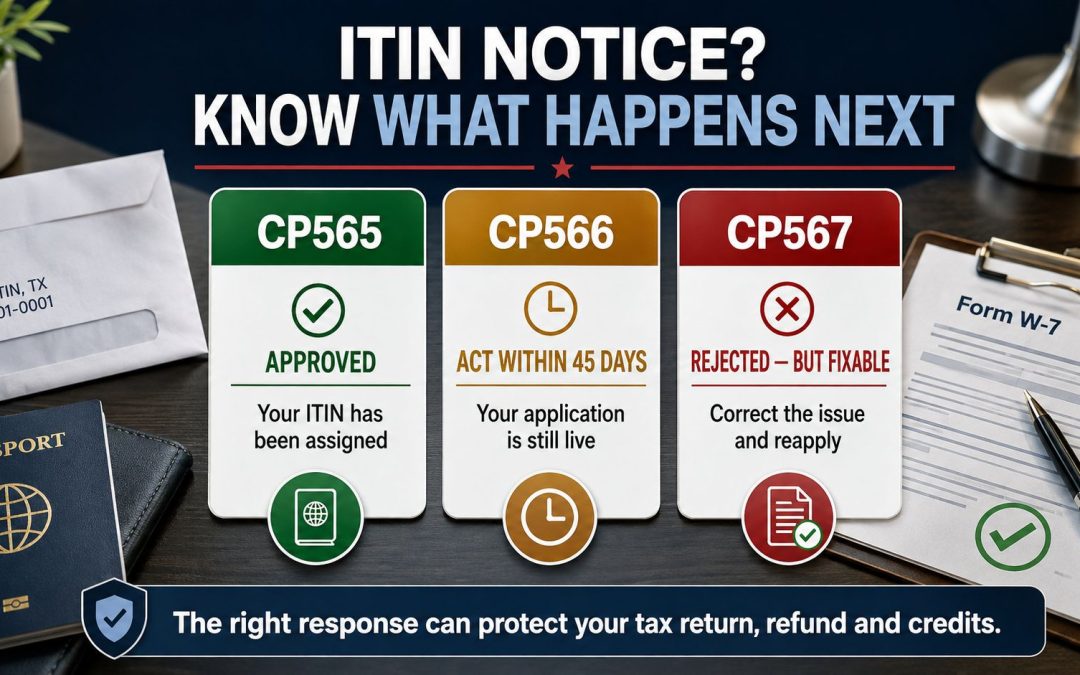
Figure 1. ITIN notices explained: CP565 confirms approval, CP566 requires action within 45 days, and CP567 means the application was rejected but can be corrected and resubmitted.
First, identify which notice you are holding
The three notices are frequently discussed together, and they are frequently confused. They sit at three different points in the process.
| Notice | What it means | Is the application dead? | What you must do |
|---|---|---|---|
| CP565 | Your ITIN has been assigned. The notice states the number itself. | No — this is the approval. | Store the notice safely and use the ITIN on every future US filing. An ITIN not used on a federal return for three consecutive years expires on 31 December of that third year. |
| CP566 | The IRS needs more information or better documentation before it can decide. | Not yet. It is a warning shot. | Reply with the Response Form and the requested documents within 45 days of the notice date. |
| CP567 | The application has been rejected. No ITIN has been issued. | Yes, that application is closed. | Diagnose the reason, correct it, and submit a fresh Form W-7 package. |
If you would like a plain-language walkthrough of all three notices side by side, our sister practice has published a companion guide to IRS notices CP565, CP566 and CP567 that covers the same ground from a general practice perspective.
If you have a CP566: you still have a live application
A CP566 is the most recoverable position, and also the one most often wasted. The notice carries a hard deadline. The IRS gives you 45 days from the date of the notice to reply, and states plainly that if it does not receive your response form and supporting documentation in that window it will reject the application and you will have to submit a new one. There is no automatic extension.
What the IRS asks for in a CP566 usually falls into one of four categories:
- Identity documents that do not meet the standard. A photocopy, a scan, a notarised copy from a local notary, or an expired passport will all trigger this. The IRS accepts originals, copies certified by the issuing agency, or copies authenticated by an IRS Certifying Acceptance Agent. The one notable exception is that spouses and dependants of US military personnel applying from an overseas or APO/FPO address may submit notarised copies.
- Proof of the US tax purpose. If you applied under an exception rather than with a tax return, the IRS wants the supporting letter, contract, statement or withholding document that proves the exception applies.
- Proof of foreign status. A passport normally covers both identity and foreign status. Anything less and you will need a second document.
- Dependant-specific evidence. Residency evidence such as medical or school records for a dependant, or a civil birth certificate showing the relationship.
Respond in one complete package. Partial responses are the single most common reason a CP566 turns into a CP567 a few weeks later. Send the Response Form itself, a copy of the CP566, and every document requested, to the address printed on the notice: Internal Revenue Service, ITIN Operation, P.O. Box 149342, Austin, TX 78714-9342. Use a trackable service.

Figure 2. CP566 response checklist: send the response form, a copy of the notice and every requested document as one complete, trackable package within 45 days.
If you have a CP567: understanding why it was rejected
A CP567 does not always spell out the reason in a way that is easy to act on. In our experience the great majority of rejections trace back to one of the following.

Figure 3. Common CP567 rejection causes and the route back: identify the reason, correct the documentation, prove the tax purpose and submit one complete Form W-7 package.
-
Document certification that the IRS will not accept
This remains the largest single cause. A local notary’s stamp, a solicitor’s certification, or a copy certified by anyone other than the issuing authority or an IRS-authorised agent will not satisfy the ITIN Operation. If you are outside the United States and do not want to post your passport to Texas, the practical alternatives are certification at a US embassy or consulate, or authentication by a Certifying Acceptance Agent. A CAA can authenticate all identity documents for the primary and secondary applicant with the narrow exception of foreign military identification cards; for dependants a CAA may authenticate the passport and the civil birth certificate, with any other document sent to the IRS in original or certified form.
-
The tax purpose was not established
An ITIN is not issued because you would find one useful. It is issued because you have a federal tax purpose. A W-7 submitted without an attached federal return, and without qualifying under one of the published exceptions, will be rejected. This catches out people applying to open a bank account, to trade US stocks, or to register on a marketplace platform without a corresponding filing obligation.
-
Mismatched names, dates or signatures
The name on the W-7, the name on the passport, the name on the attached tax return and the signature all have to agree. Middle names dropped on one document, transliterated spellings, married versus maiden names, and date formats written the European way rather than the US way all cause failures. It is a clerical problem with an expensive consequence.
-
You already have a number in the IRS system
One published version of the CP567 states that the application was rejected because IRS records show an ITIN has already been assigned. Sometimes that number exists but has expired through non-use, in which case the correct action is a renewal rather than a first-time application. A related situation arises where the IRS has issued an Internal Revenue Service Number instead — a temporary number that looks similar but is not an ITIN. If your notice refers to a number you do not recognise, read our explanation of ITIN rejections involving an IRSN before you reapply, because submitting a fresh W-7 in this situation is often the wrong move.
-
The applicant is eligible for a Social Security Number
If you are eligible for an SSN, you cannot hold an ITIN, and you cannot hold both at once. Work authorisation obtained between application and processing can therefore produce a rejection.
Can you appeal a CP567?
Not the ITIN decision itself. There is no appeals procedure and no reconsideration form for an ITIN rejection, because a rejection is not an assessment of tax. The only remedy the CP567 offers is a fresh, complete application.
That is separate from the tax consequences. If the IRS goes on to adjust your return to strip out a credit that depended on the missing number, the resulting math-error notice carries its own sixty-day right to request abatement, which forces the IRS into ordinary deficiency procedures and opens the usual routes of challenge. Do not confuse the two: the sixty-day clock on that notice is real, and short.
On the ITIN itself, your practical options are these:
- Reapply with a corrected package. This is the normal and usually the fastest route. In practice there is no cap on how many times you may apply, and a previous rejection does not prejudice a later application.
- Call the IRS ITIN Operation to clarify the reason. 800-908-9982 from within the United States, or +1-267-941-1000 from overseas, which is not a toll-free line. Have the notice and its case reference number in front of you. This is worth doing when the stated reason is genuinely ambiguous.
- Apply in person at a Taxpayer Assistance Centre. If you are in the United States and can secure an appointment, this is free. TAC staff will review your completed Form W-7, authenticate most supporting documents — in fact a wider range than a CAA may, with school and medical records for dependants the main exclusion — hand your documents back at the end of the appointment and forward the package. Arrive with the form already filled in; they will not prepare your tax return.
- Use a VITA site offering ITIN services, where one operates near you. This is another free channel and is easy to overlook.
- Apply through a Certifying Acceptance Agent, in which case your documents are returned to you rather than posted to Austin, and the package is reviewed against IRS requirements before it is submitted.
- Contact the Taxpayer Advocate Service where a rejection has produced genuine financial hardship — for example a substantial refund that cannot be released — and ordinary channels have failed.
The step-by-step route back after a rejection
- Read the notice line by line and keep the original. Note the case reference number and the date. You will need both.
- Establish the exact reason. If the notice is unclear, telephone the ITIN Operation before you spend money on new documents. Reapplying against a guessed reason is how applicants end up with three rejections instead of one.
- Rebuild the identity documentation to IRS standard. Original passport, a certified copy from the issuing authority, or CAA authentication. Nothing else.
- Re-establish the tax purpose. Attach the federal return, or the exception documentation, and make sure the reason code ticked at the top of the W-7 matches what you have attached.
- Reconcile every name, date and signature across the W-7, the passport, the tax return and any supporting letter.
- Submit a complete package with a short covering letter that references the earlier CP567 and explains what has been corrected. This is not required, but it helps the reviewer.
- Track the timeline. The IRS asks you to allow around seven weeks for notification, and nine to eleven weeks between 15 January and 30 April or where the application is made from overseas. Treat those as published targets rather than guarantees; the Taxpayer Advocate has repeatedly reported real-world ITIN processing running well beyond them. Our detailed breakdown of how long it takes to get an ITIN in 2026 sets out what to expect at each stage.
Do not lose sight of the tax return sitting behind the ITIN
The rejection is rarely the whole problem. A W-7 is usually attached to a federal return, and when the ITIN is refused, that return is generally processed without whatever benefit depended on the number — joint filing or head-of-household status, a dependant-related credit, a treaty position, or a withholding credit. The IRS may use its math-error authority to strip the claim out without any further correspondence.
Whether you can get that benefit back later turns on a detail almost nobody knows about until it is too late. Where the original Form W-7 was filed on or before the due date of the return, including extensions, an ITIN issued afterwards is treated as having been in place by that date, and the benefit can normally be restored on Form 1040-X. Where the W-7 went in late, the dependant credits — the Child Tax Credit, the Additional Child Tax Credit and the credit for other dependants — are lost for that year and no amendment will recover them. Treaty positions, withholding credits and filing status are more forgiving, but the credits are not.
This is the single strongest argument for dealing with a CP566 or CP567 immediately rather than at leisure. A rejection that is fixed within the filing season is an inconvenience. The same rejection fixed eight months later can be permanently expensive.
Refund claims are the other sharp edge. A refund is generally only available for three years from the date the return was filed, or two years from the date the tax was paid, whichever is later. Applicants reclaiming over-withheld tax on Form 1042-S income, or waiting on a FIRPTA refund after selling US property, can lose real money to that clock while a rejection is being sorted out. If a property sale is involved, the withholding side should be dealt with in parallel rather than afterwards — our guide to Form 8288-B and FIRPTA withholding reduction explains why timing matters more than almost anything else in that situation.
How to reduce the chance of a second rejection
The pattern we see is consistent. Applications fail on documentation and on evidence of tax purpose, not on eligibility. Most rejected applicants were entitled to an ITIN all along.
Working through an IRS Certifying Acceptance Agent addresses both failure points directly. The agent examines your original identity documents or certified copies from the issuing agency, conducts the interview the IRS requires — which may be held by video, although the documents themselves must still physically reach the agent — issues a Certificate of Accuracy on Form W-7 (COA) alongside the application, and reviews the tax purpose and the attached return before anything is posted. The important practical difference is that your passport comes back to you from the agent rather than travelling to Texas and waiting there.
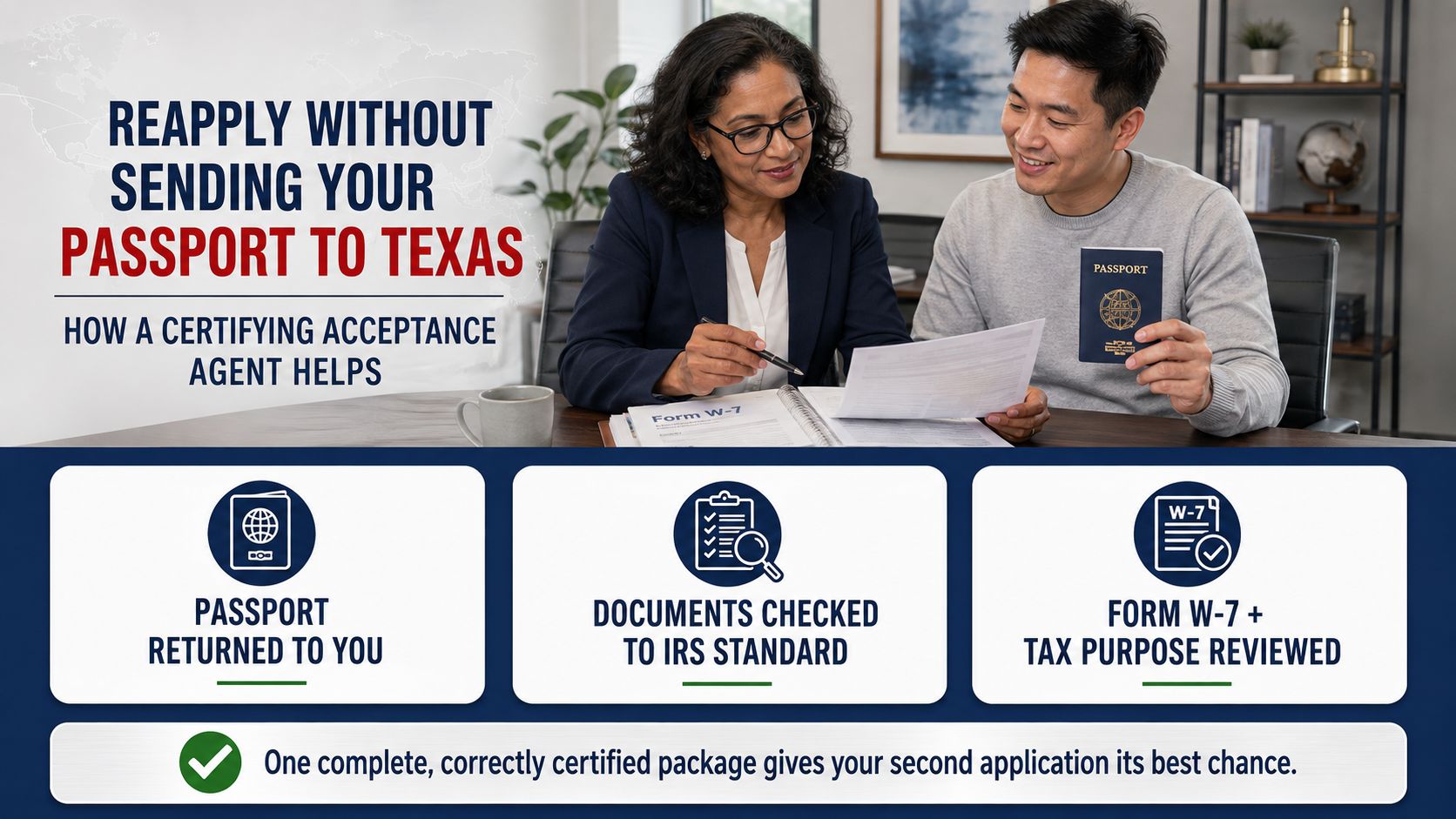
Figure 4. A Certifying Acceptance Agent can authenticate qualifying identity documents, review Form W-7 and the tax purpose, and return the passport to the applicant rather than sending it to Texas.
If you would like the package prepared and checked before it goes to Austin, our ITIN preparation and advisory service is built for exactly this situation, and we handle a steady volume of second-attempt applications after a CP567.
A note for accountants, CPAs, EAs and Acceptance Agents worldwide
This next section is addressed to fellow professionals rather than to individual applicants.
If you hold a valid IRS Acceptance Agent or Certifying Acceptance Agent licence, or you are a CPA, EA, chartered accountant or tax adviser whose clients periodically need ITINs, you will know the economics of this work. ITIN applications are documentation-heavy, deadline-sensitive and low-margin when handled occasionally. They are efficient only at volume, and the rejection rate for firms that prepare a handful a year is materially higher than for firms that prepare them constantly.
The requirements also keep moving. From 1 June 2026, for example, Exception 1(a) partnership applications must include the portion of the partnership or LLC agreement showing the entity name, the EIN and the applicant’s name and signature. Small changes like that are easy to miss if ITIN work is a sideline, and each one is a rejection waiting to happen.
We would like to work with you rather than compete with you.
The arrangement we offer is straightforward. We take on the parts that benefit from volume — client intake and information gathering, preparation of the Form W-7, review of supporting documentation against current IRS requirements, preparation of the attached federal return or exception documentation, assembly of the submission package, and follow-up with the ITIN Operation where a CP566 or CP567 arrives. You retain the client relationship and, where you hold the CAA licence, you conduct the identity verification and passport authentication in your own jurisdiction and sign the Certificate of Accuracy. We can work on a B2B basis behind your brand, or take a direct referral and serve the client as a B2C engagement, whichever suits your practice.
Where we do not have coverage in a particular country, we are equally happy to send referrals in the other direction to licensed agents who can perform in-person verification locally.
Terms, plainly stated. Any partnership is governed by a written agreement setting out the scope of work and the contractual fees before work begins. The signing agent or licence holder retains full professional responsibility for the accuracy and completeness of everything they certify and submit under their own licence, including the identity verification they perform and the Certificate of Accuracy they sign. We prepare and review; we do not assume the certifying agent’s statutory obligations, and no arrangement with us alters your duties to the IRS or to your own regulator.
If that is of interest, write to [email protected] with your firm name, jurisdiction, licence status and rough annual ITIN volume, and we will come back to you with a proposal.
Frequently asked questions
Is a CP565 a rejection?
No. A CP565 is the notice confirming that the IRS has assigned your ITIN. It contains the number itself. Keep it permanently.
How long do I have to respond to a CP566?
You have 45 days from the date of the notice. If the IRS does not receive your response form and documentation in that window, it will reject the application and you will have to submit a new one.
Can I appeal a CP567 rejection?
There is no formal appeal process for the ITIN decision itself. The remedy is to correct the problem and submit a new Form W-7 application. If the IRS separately adjusts your tax return to remove a credit, that math-error notice carries its own 60-day right to request abatement, which is a different process with a much shorter deadline.
How long does a re-application take?
Allow around seven weeks for the IRS to notify you of the outcome, or nine to eleven weeks if you apply between 15 January and 30 April or from outside the United States.
Will a previous rejection count against me?
No. Each Form W-7 is assessed on its own merits. A prior CP567 does not prejudice a later application, provided the underlying issue has been corrected.
Do I have to post my passport to the IRS?
No. You can present your original documents to an IRS Certifying Acceptance Agent or to a Taxpayer Assistance Centre, both of which return them to you, or obtain a certified copy from the issuing authority or a US embassy or consulate.
Does a rejection mean my ITIN has expired, or that I never had one?
They are different problems. If the IRS says a number is already assigned, check whether it is an existing ITIN that has expired through three consecutive years of non-use. If so, the correct route is a renewal, not a first-time application.
What if the IRS says I already have an ITIN or an IRSN?
Do not simply reapply. An IRSN is a temporary internal number, not an ITIN, and the correct action depends on which number the IRS holds against your record. Contact the ITIN Operation or take advice first.
In closing
A CP567 is a setback, not a verdict on your eligibility. A CP566 is an opportunity that expires. Treat both as document problems, because that is nearly always what they are, and deal with them in one complete, correctly certified submission rather than in instalments.
If you have received either notice and would like the position reviewed before you spend money reapplying, get in touch with our team with a copy of the notice and we will tell you what we think went wrong.
Disclaimer: This article is general information current as at August 2026 and is not tax, legal or immigration advice. IRS procedures, processing times and documentation requirements change. You should not act on this material without obtaining advice specific to your circumstances. Verify current requirements with the IRS at irs.gov or with a qualified adviser before submitting an application.