
Kader Ameen, EA, FMAAT. Official IRS and Hawaii Department of Taxation sources checked 14 November 2026.
You agree a price for your Hawaii property, then find out a large amount may be held back at closing. Someone mentions HARPTA. Someone else asks for an ITIN. Nobody explains whether that money is your final tax bill.
If you’re selling Hawaii property from overseas without an SSN, these questions belong together. Hawaii withholding, federal withholding and your tax ID need joined-up planning, but each follows its own rules. Sorting them out before closing makes the paperwork, and the cash you can expect to receive, much clearer.
HARPTA and ITIN: the quick answer
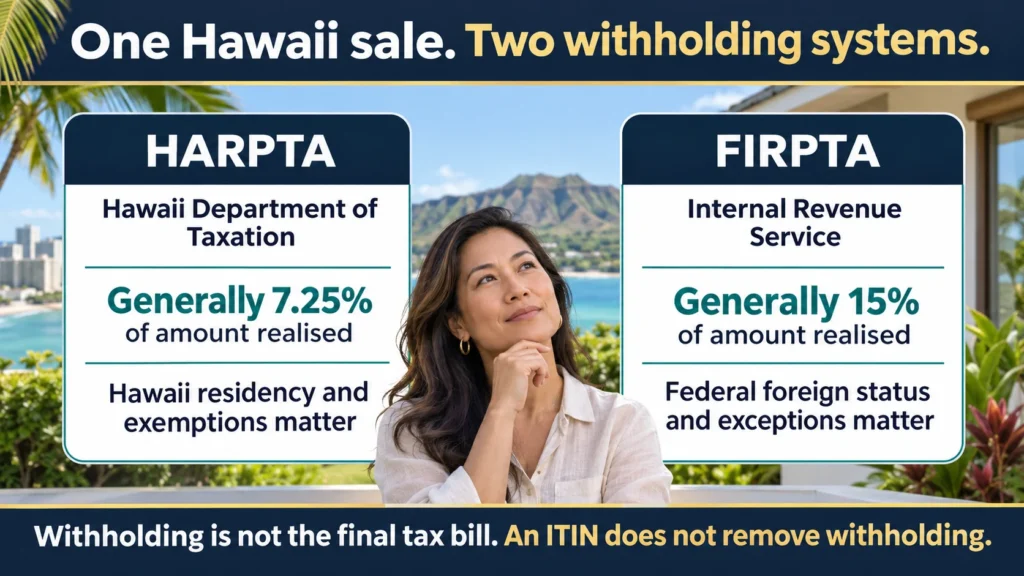
HARPTA is Hawaii’s property withholding system. Standard HARPTA withholding is 7.25% of the amount realised, which is generally the sale price, unless an exemption or approved adjustment applies. FIRPTA is a separate federal regime for foreign sellers and generally requires 15%, with exceptions and reduced rates in specific cases. Both can apply to the same Hawaii sale. [1, 2, 3]
An Individual Taxpayer Identification Number (ITIN) identifies an eligible person for federal tax purposes when they can’t get a Social Security number. It helps with reporting and with matching withholding credits to you. It doesn’t exempt you from HARPTA or FIRPTA, and getting one doesn’t mean you’re due a refund. [4]
Hawaii nonresident and foreign seller mean different things
HARPTA stands for the Hawaii Real Property Tax Act, and its residency test is about Hawaii. FIRPTA stands for the Foreign Investment in Real Property Tax Act and uses federal rules to decide whether you’re foreign. Citizenship, immigration status and tax residency aren’t interchangeable.
For example, a U.S. citizen living in California with only a temporary presence in Hawaii may face HARPTA withholding when selling Hawaii property, but is normally outside FIRPTA as a U.S. person. That seller would usually use an SSN, not an ITIN. A foreign individual who is nonresident under both systems may face both. Property owned through an entity needs its own analysis. [1, 3]
Hawaii residents need the right paperwork too. Hawaii explains that a buyer can’t just skip withholding because they know the seller lives there: a valid Form N-289 certification is needed for that residency exemption. Never sign a residency certificate that doesn’t match your facts. [1]
How much could be withheld at closing?
Take an illustrative sale by someone who is both a Hawaii nonresident and a foreign person for federal purposes. Say the amount realised is $800,000, the buyer is purchasing an investment property, and no exemption or withholding certificate applies.
- HARPTA at 7.25% would be $58,000.
- FIRPTA at the standard 15% would be $120,000.
- Combined withholding would be $178,000 before any other closing deductions.
That’s an illustration of cash held back, not a statement that the seller owes $178,000 in final tax. The amount realised can include debt and non-cash consideration, so it isn’t necessarily the cash you receive. Hawaii and federal tax must each be worked out separately under their own rules. [2, 3]
The example uses an investment purchase on purpose. Federal rules based on the buyer’s residence can change the result: a qualifying purchase of $300,000 or less may escape FIRPTA withholding, while a qualifying residence purchase above $300,000 and up to $1 million may attract 10%. Those federal tests don’t automatically create a Hawaii exemption. Our guide to FIRPTA withholding exceptions and Form 8288-B covers the federal side in more detail. [5, 6]
Where your ITIN fits in
If you already have an SSN, use it. If you’re eligible for an SSN, an ITIN isn’t the alternative route. An EIN identifies a business or other entity for tax purposes; it doesn’t replace an individual seller’s SSN or ITIN. (Our SSN, EIN, ITIN and Form W-7 FAQ explains the differences.) [4, 14]
A foreign seller without an SSN may need Form W-7 to get an ITIN for federal reporting or a tax return. Check each co-owner separately rather than assuming one spouse’s number covers both. Names, ownership details and ID numbers should match across the sale documents and withholding records.
Hawaii’s published N-15 instructions allow an IRS-issued ITIN in the SSN boxes and warn that a missing valid number can delay a refund. But needing to file in Hawaii shouldn’t be presented as the federal reason for a Form W-7 application. Establish the correct federal basis first. [4, 7]
An ITIN doesn’t give you permission to work or any immigration status. For a fuller explanation, see our ITIN application guidance.
Can you apply for an ITIN before filing your annual return?
Form W-7 usually goes in with a federal income tax return unless a documented exception applies. Exception 4, the property transaction exception, can support certain applications linked to federal withholding or reporting on a foreign person’s sale of U.S. property. The evidence you need depends on the actual transaction and application route. [4]
IRS guidance says that, without another valid reason, a foreign seller can’t get an ITIN just because a sale is planned. A legally binding sale contract can create a valid reason to apply. Review the contract and the relevant Forms 8288, 8288-A or 8288-B rather than sending a passport with a general request for a tax number. [8]
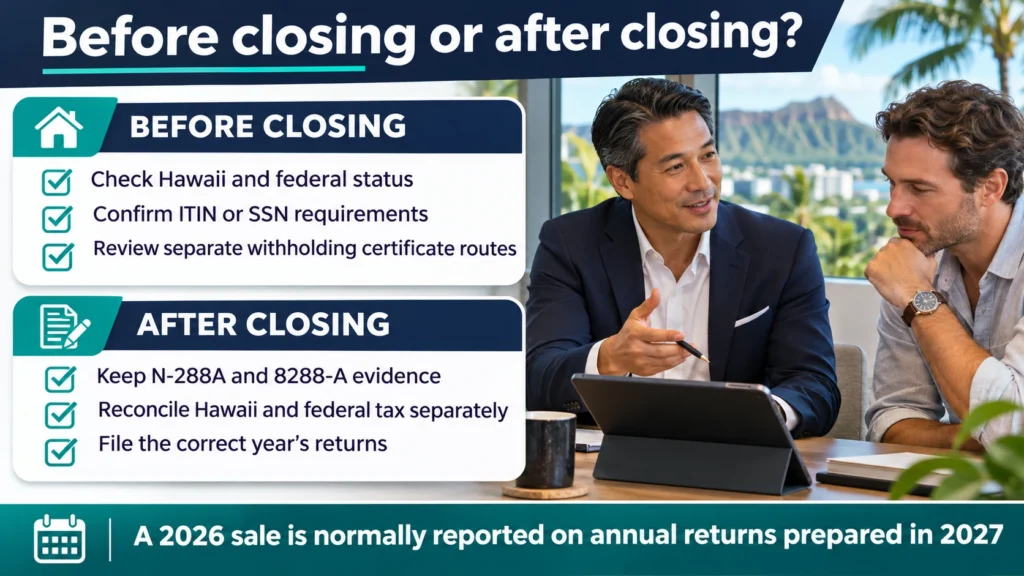
If the property sells in 2026, the annual 2026 federal and Hawaii returns are normally prepared after the year ends, in 2027. That doesn’t mean everything waits until then: a qualifying ITIN application, a withholding certificate request or a Hawaii tentative refund application may have an earlier route. [4, 9]
Two withholding certificate applications with different rules
Hawaii Form N-288B
Form N-288B is Hawaii’s application to adjust or waive withholding. The permitted grounds include no gain, and insufficient proceeds after specified costs. A modest taxable gain on its own isn’t a general right to reduce withholding with this form. Submit the required calculations and evidence at least 10 working days before transfer: the Department won’t approve it once the transfer date has passed. [10]
Federal Form 8288-B
Federal Form 8288-B is a separate IRS withholding certificate application. An eligible request can ask for reduced withholding based on the federal facts. Submitting it on time, by the transfer date, with the required buyer notice can postpone payment of the withholding while the IRS decides. It doesn’t simply release the money to the seller. Agree the exact conditions with the buyer and the escrow team. [6, 11]
A Hawaii approval doesn’t approve the federal request, and a pending IRS application doesn’t extend Hawaii’s deadline. Keep separate correspondence and instructions for each authority.
After closing: protect the evidence for both credits
Under the standard Hawaii process, the buyer files Forms N-288 and N-288A with payment by the 20th day after transfer. Separate N-288A statements are needed for each relevant nonresident seller, including spouses. Federal Forms 8288 and 8288-A follow their own reporting and payment rules, normally also tied to the 20th day after transfer unless an exception changes the timing. [2, 6]
Ask for the closing statement, ownership split, state withholding statement and federal withholding records. The IRS normally provides a stamped Copy B of Form 8288-A so you can claim the federal credit. If the seller’s TIN is missing, that stamped copy may not be issued until the number is supplied. Missing ID doesn’t excuse the buyer from filing. [6]
How Hawaii and federal refunds are reconciled
An individual Hawaii nonresident will generally use Form N-15 to report the sale and reconcile the Hawaii withholding. A foreign individual’s federal filing may be Form 1040-NR, depending on tax status, while U.S. citizens and resident aliens generally use Form 1040. Don’t pick the return based only on the passport shown at closing. If you need help with the federal return, see our US personal tax return service. [7, 13]
Hawaii Form N-288C offers a possible tentative refund before the annual return is available or before the tax year ends, subject to its instructions. Wait until the Department confirms it has received the withholding payment. The form is optional, doesn’t replace the annual Hawaii return, and is rejected if filed after the annual return’s due date. A valid tax ID number is needed to process N-288C; sellers without one are directed to the annual state return route after year end. [9]
Keep purchase and sale statements, improvement invoices and rental depreciation schedules. A mortgage payoff isn’t a tax deduction, and a small cash balance doesn’t prove there was no gain. Any refund depends on the final calculations and credits; not every dollar withheld comes back automatically.
Your practical checklist for a 2026 Hawaii property sale
- Confirm who the seller is, the legal ownership, and each owner’s Hawaii and federal tax status.
- Check each owner’s SSN or ITIN position and whether any ITIN needs renewing.
- Review the contract, the expected closing date and both withholding calculations.
- Look at exemption certificates and state or federal applications early.
- Keep the withholding evidence safe and plan the correct year’s returns.
Accountants, property advisers and escrow teams should spot these issues before closing instructions are finalised. For sellers based in the UK, Singapore, Dubai or India, distance adds document and communication planning, but it doesn’t decide either withholding outcome. For broader federal questions, see our sister practice’s guide for a foreign national selling U.S. property.
Frequently asked questions
Does an ITIN remove HARPTA withholding?
No. An ITIN is an identification number. An exemption or approved adjustment needs its own legal basis and documentation.
Can a U.S. citizen face HARPTA?
Yes. A U.S. citizen who is not a Hawaii resident may face Hawaii withholding, even though FIRPTA ordinarily does not apply to that person.
Do I need two different ITINs for Hawaii and the IRS?
No. An individual has one IRS-issued ITIN. Hawaii’s N-15 instructions allow that number in the relevant SSN fields.
Is all withholding refunded after I get an ITIN?
No. Identification helps administer the claim. Any refund depends on the relevant tax liability, available credits and correct filings.
Can I file N-288B after the sale has closed?
No. Hawaii requires advance submission and does not approve N-288B after transfer. Review the annual return or N-288C route instead, as appropriate.
Plan your ITIN and filing route early
If you’re selling, or have sold, Hawaii property without an SSN, send us an ITIN enquiry about application preparation and how it fits with your tax filing. Tell us whether you have a signed contract, whether closing has happened and whether federal or Hawaii tax has already been withheld.
Where passport certification is needed, it’s coordinated with a separately authorised CAA, subject to current authorisation and availability. An eligible CAA document route can mean you don’t have to mail accepted original passports to the IRS. Preparation alone doesn’t authenticate documents. [12]
Have your Hawaii withholding, federal withholding and ID requirements each been checked separately?
Sources
Checked against IRS and Hawaii Department of Taxation publications on 14 November 2026. The current N-15 instructions reviewed are for 2025; use the final 2026 forms and instructions when filing in 2027.
- Hawaii Tax Facts 2010-1: Understanding HARPTA (revised April 2025)
- Hawaii Form N-288 and instructions
- IRS: FIRPTA withholding
- IRS: Form W-7 instructions and exceptions
- IRS: Exceptions from FIRPTA withholding
- IRS: Form 8288 instructions (January 2026)
- Hawaii Form N-15 instructions
- IRS: FIRPTA questions 12 and 13 on ITIN applications
- Hawaii Form N-288C and instructions
- Hawaii Form N-288B and instructions
- IRS: Withholding certificates
- IRS: ITIN documentation FAQs
- IRS: Nonresident aliens
- IRS: Employer identification numbers
This article is general educational information, not individual tax or legal advice. Each situation may vary. Outcomes depend on ownership, residency, tax year, documents and applicable law. Please get professional advice before acting. No adviser-client relationship, ITIN approval or tax refund is guaranteed.